The quality and sophistication of internet connected software defined radio receivers (SDRs) advanced substantially in 2025. Radio hobbyists have been setting up their broadband SDRs with an open source web interface named NovaSDR, which allows the receivers to be operated from a web browser. Other interfaces have been in use for a while, but the NovaSDR combines massive multi-listener capacity with broad compatibility with a lot of hardware types. Operators are sharing several of these on the internet, so anyone, anywhere, may tune the bands as though they were present at the receiver location.
My favorite NovaSDR sites, by far, are the sites using the wideband, direct sampling, RX-888 receiver (made by Hugen Technology Company). If you are into shortwave listening, amateur radio, or just want to experience radio outside of your country or region, check out some of the cool things I include below! There is always something happening out there that you won't want to miss!
Talk Radio and Aero Monitoring from Pennsylvania
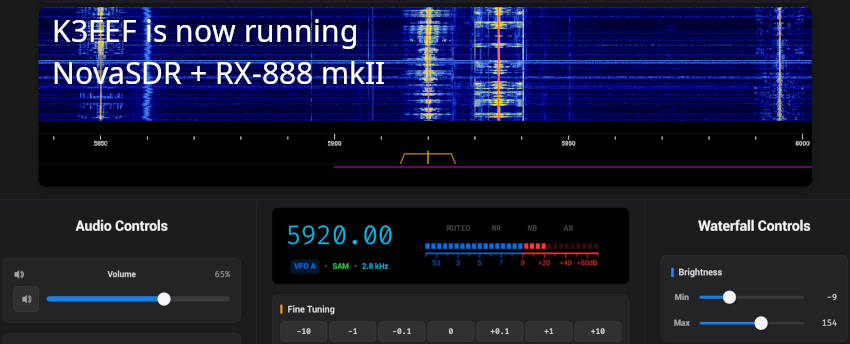
Located just a little southwest of New York City, the K3FEF SDRs are set up in a low noise location and on some excellently crafted antennas. It picks up great mediumwave signals from all around the region. During the daytime, there is no better receiver for WNYC 820 kHz, with news, music, and talk on current events. WGY 810 kHz comes in pretty well from Schenectady too! If you can pronounce it properly, take ten points and tune in for a listen sometime. If you are more into billionaire funded MAGA propaganda, then WABC 770 kHz may be more suitable for you. Have fun with that...
You might notice that these broadcasters use AM mode, but the links I set use "SAM" mode. That invokes the synchronous demodulator which has superior audio fidelity, even if the signals are weak, fluttery, and subject to fading or interference. Definitely use "SAM" when available!
 Listen for some
As much fun as mediumwave is on the K3FEF NovaSDR, don't miss the plethora of happenings on shortwave bands. Military and oceanic air traffic communications are prime, as the receiver is close to plenty of offshore routes and operations areas.
Monitor some HF aero traffic as flights make their way out or back across the Atlantic Ocean on 8825 kHz and 8846 kHz.
Monitor military aero comms and strategic forces on 8992 kHz and 11175 kHz.
Check out the Firedrake Jammer, on for hours with Chinese classical and operatic music, transmitting from the other side of the world. Listen on 13810 kHz and 11650 kHz.
Aero Radio and Ham Bands from Northern Georgia
Another low noise, high sensitivity NovaSDR site is located in the state of Georgia, run by amateur radio NY4Q. It began as the Lumpkn Schools WebSDR and now has upgraded wideband direct sampling hardware (another RX-888). From this receiver, there is close proximity to air routes between the northeast, Puerto Rico, and the Virgin Islands. Those Routes are known collectively as the Western Atlantic Route System (WATRS):
New York (WATRS) 8918 kHz | New York (WATRS) 6577 kHz | New York (WATRS) 5550 kHz
During hurricane season, amateur radio operators carry out emergency communications as a public service for those who are experiencing power and phone outages. Considering the warmer and warmer climate trends, expect multiple activations. Listen on 40 and 20 meter bands:
Hurricane Net 14325 kHz | Hurricane Net 7268 kHz
Music and Banter from Brazil
When I first began shortwave listening, the "tropical bands" were a fun place to find broadcasters near the equator. Because of ever present thunderstorms in the intertropical convergence zone, mediumwave frequencies are too noisy, driving stations to operate near 5 MHz. Not only are the static crashes less intense at that higher frequency, but signal propagation extends for much longer distances. Night time propagation at 60 meters can bring in signals from anywhere on the dark side of the earth.
Enjoy an afternoon or evening with Brazil's Radio Nacional da Amazonia. They run a mix of music and talk, on a strong radio signal. The station is an easy catch on the 49 and 25 meter bands:
Radio Nacional da Amazonia 11780 | Radio Nacional da Amazonia 6180
If you enjoy the music, banter, and style of the Brazillian broadcasters, here is a list of more! In a way, they are the South American equivalent of the European music stations on the upper end of the 49 meter band. As always, I suggest listening from an internet SDR more close to the transmitters; many stations are on shared frequencies and running lower power. Remember, lower frequencies at night, higher ones during daytime:
Rádio Aparecida – 5035 kHz | 9630 kHz | 11855 kHz
Rádio Brasil Central (EBC) – 4985 kHz | 11815 kHz
Rádio Clube do Pará – 4885 kHz
Rádio Difusora do Amazonas – 4805 kHz
Rádio Educadora – 2380 kHz | 3375 kHz | 4825 kHz
Rádio Gaúcha – 6020 kHz | 11915 kHz
Rádio Guaíba – 6000 kHz | 11785 kHz
Rádio Marumby – 6080 kHz | 9515 kHz
Rádio Inconfidência – 6010 kHz
Rádio Gazeta – 5955 kHz | 11685 kHz | 15325 kHz
Rádio Bandeirantes – 6090 kHz | 9645 kHz
Rádio Record – 6150 kHz | 9505 kHz
Rádio CBN Anhanguera – 4905 kHz | 11830 kHz
Rádio Transmundial – 9530 kHz | 11735 kHz
Rádio Canção Nova – 4825 kHz | 9675 kHz
Rádio Voz Missionária – 9665 kHz
Rádio Cultura – 6170 kHz
Rádio Alvorada – 6085 kHz | 11965 kHz
As I write this, it appears that the LU5DNP SDR receiver is down for maintenance... Keep checking the site, as it is in a great location for receiving signals from Brazil and other South American countries.
BBC and Music Stations from Europe
Two NovaSDR sites are worth bookmarking in your web browser for tuning in broadcasters in Europe. I will often have mediumwave broadcasters tuned up, such as call-in programming on BBC 5 Live on 693 kHz. I will tune them in from the NovaSDR in Heppen, Belgium, operated by Bas, amateur radio ON5HB. Yet again, the site is another RX-888 in a low noise location and connected to an excellent antenna.
The other site is an internet SDR long-timer, which operated a classic WebSDR for years. In 2025, radio operator Gianni IS0/HB3XDC upgraded to a wideband direct sampling radio. Located in Sardinia, it can receive longwave and mediumwave from Europe, northern Africa, and as far east as Syria and Israel. Shortwave reception is global. It is especially good for daytime reception of music stations like Channel 292 on 6070 kHz and Radio Veronica on 5955 kHz.
Well, there they are, friends! Some fun listening for you on internet connected SDRs using the NovaSDR interface. If you want to experience the bands as though you were at these sites and plugged into their antennas, just click and go. Have fun and learn what it is like to operate truly high performance radios.
© 2015 - 2026 Skywavelinux.com, All Rights Reserved.
Written and curated by Webmaster - Developer Philip Collier
Contact, Privacy Policy and Disclosures, XML Sitemap.